Turn and Live
A reflection on repentance, personal responsibility, and the mercy of God in Ezekiel 18
Reading Ezekiel, I came across a footnote about the Holiness Code - a section of Leviticus that outlines what holiness looks like in the daily life of God’s people. Ezekiel echoes many of these commandments, describing what a righteous life looks like. It made me wonder: what does Scripture actually say about walking the right path?
If a man is righteous and does what is lawful and right - if he does not eat upon montains, or lift up his eyes to the idols of the house of Israel, does not defile his neighbours wife or approach a woman in her time of impurity, does not oppress any one, but restores to the debtor his pledge, commits no robbery, gives his bread to the hungry and covers the naked with a garment, does not lend at interest or take any increase, witholds his hand from iniquity, executes true justice between mand and man, walks in my statutes, and is careful to observe my ordinances - he is righteous, he shall surely live says the LORD God.
Ezekiel 18:5-9
At first, the list seems overwhelming. Yet Jesus Himself later summarised the entire Law and the Prophets into two commandments (Matthew 22:37-40):
- Love God with all your heart, soul and mind
- Love your neighbour as yourself
Ezekiel’s list is, in many ways, what those commandments look like in practice.
Any form of idolatry keeps us from God. It does not matter whether it is a carved idol or something less obvious - money, power, status, success, or even ourselves. One must place God above all things, for every good gift ultimately comes from Him (James 1:17).
Loving our neighbour means treating others as we would our own family - or even ourselves. If we truly loved one another this way, we would not do any of the things Scripture warns against. We would not exploit others, but would freely share our blessings, care for those in need and seek their good before our own.
Imagine a community where everyone lived this way: justice was done fairly, the hungry were fed, debts were treated with mercy, and people sought one another’s good before their own. Ezekiel is not merely describing individual morality, he is painting a picture of the kind of society God’s people were meant to become.
Scripture also reminds us that turning away from righteousness has serious consequences,
When a righteous man turns away from his righteousness and commits iniquity, he shall die for it; for the iniquity which he has committed he shall die.
Ezekiel 18:26
Yet judgment is not arbitrary. Ezekiel has already explained the principle,
The son shall not suffer for the iniquity of the father, nor the father suffer for the iniquity of the son; the righteousness of the righteous shall be upon himself, and the wickedness of the wicked shall be upon himself.
Ezekiel 18:20
No one bears guilt before God because of another person’s choices. Each of us is responsible for how we respond to God today. That is precisely why repentance is possible. A wicked person is not forever defined by his past, just as a righteous person cannot rely on yesterday’s faithfulness.
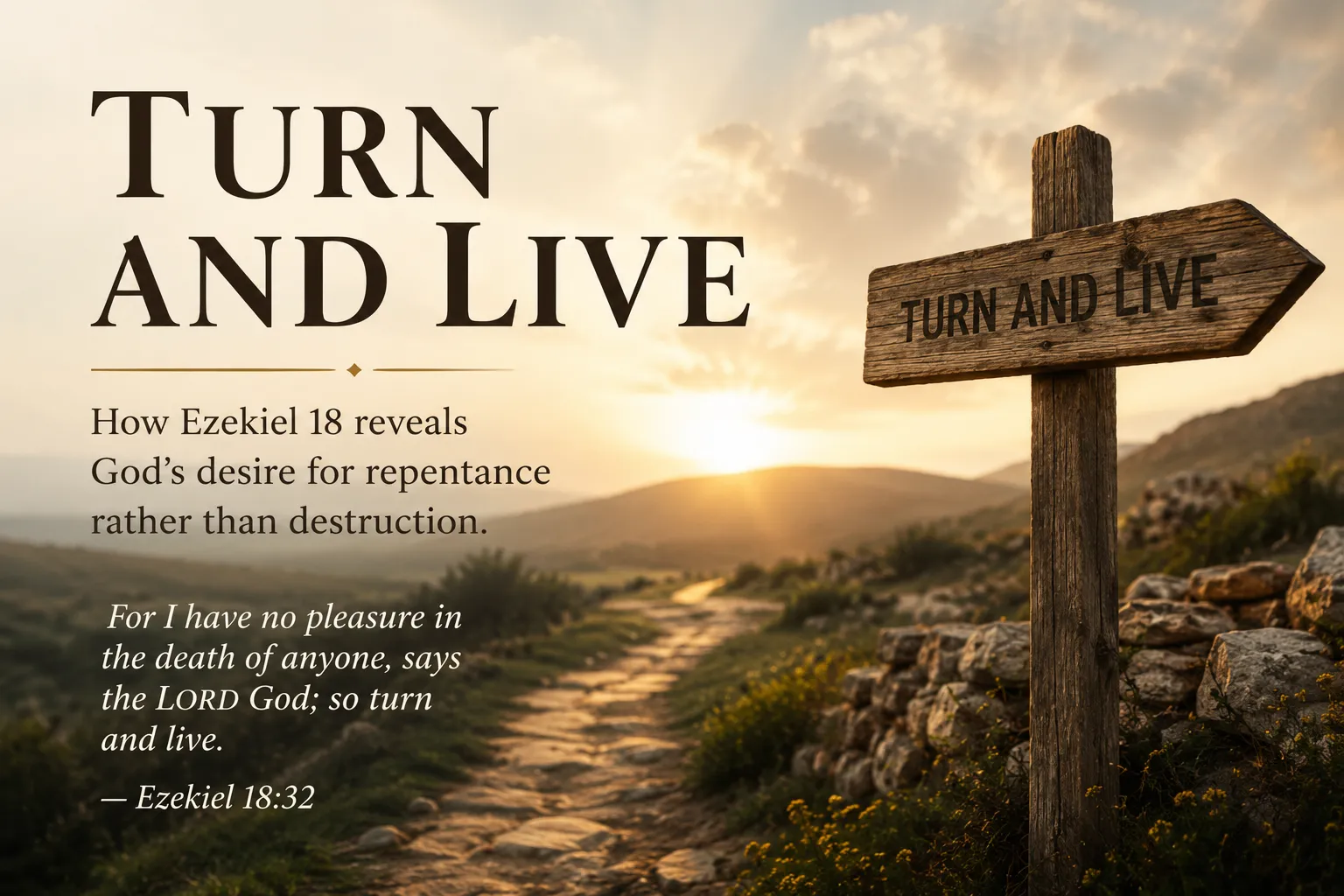
For I have no pleasure in the death of anyone, says the LORD God; so turn and live.
Ezekiel 18:32
It couldn’t be clearer that God wants us to “turn and live”. In fact, remember what Jesus said in the parable of the shepherd that the one sheep that got lost (Matthew 18:12), God wants for those who are lost to repent and come back to Him,
But if a wicked man turns away from all his sins which he has committed and keeps all my statutes and does what is lawful and right, he shall surely live; he shall not die.
Ezekiel 18:21
God’s desire has always been repentance rather than destruction. Remember also the parable of the prodigal son (Luke 15:11-32), how the father was overjoyed that his son came back to him after spending his fortune and struggling to survive?
God wants us all to repent. He even says,
None of the transgressions which he has committed shall be remembered against him; for the righteousness which he has done he shall live.
Ezekiel 18:22
How good, loving and merciful is God for allowing us to repent and start with a clean slate. Note that the Scripture mentions “None of the transgressions” will be remembered. This also points to how we should behave, remember what Jesus told us in Matthew 5:24 about how we should reconcile with a brother before bringing an offering to the altar.
Cast away from you all the transgressions which you have committed against me, and get yourselves a new heart and a new spirit! Why will you die, O house of Israel? For I have no pleasure in the death of anyone, says the Lord GOD; so turn and live.
Ezekiel 18:31-32
Ezekiel reminds us that God does not delight in judgment but in repentance. He desires people to turn and live. Jesus reveals the same heart throughout the Gospels. He welcomes tax collectors, forgives adulterers, seeks the lost sheep, and runs to meet the prodigal son. The God of Ezekiel is the Father of the prodigal son, His invitation has never changed: turn back, and live.
Why Bible Verse and Psalm Numbers Differ
While looking at the NET Bible, I really enjoyed that hovering over a passage number would pop that passage onto the page. So I went into the...
10 Aug 2026One more articleThe Call to Conquer
Why following Christ is not merely about better behaviour, but becoming someone new
Reflections · 20 Jul 2026