If God Is Love, Why Did Jesus Have to Die?
God's mercy, humanity's search and the cross.
Before I started studying the Scriptures properly, I used to get back to the thought that God used to punish those that don’t follow his commandments. Yet, the more Scripture I read the more I see how merciful God is and why punishment had to be delivered.
Another question that I often wondered was:
If God is Love and all powerful, why did Jesus have to die?
I’ve even seen someone ask this exact question in Threads at one point. Which made me ponder this question utilising Scripture in hopes to find an answer to this exact question. Perhaps the right place is to start in the very beginning…
Adam’s fall and the entrance of sin
I think everyone knows the story, God created Adam, Adam walked the Garden of Eden, was tasked to name every animal, tend the garden and live in eternal peace and happiness. With a simple commandment,
“You may eat freely eat of every tree of the garden; but of the tree of knowledge of good and evil you shall not eat, for in the day that you eat of it you shall die.”
Genesis 2:16-17
Note what was said. Adam could eat from every tree - every single one of them. The only rule was, don’t touch that single one. So Adam kept going on his day to day, but Adam was alone and couldn’t find a companion in the Garden.
God made Adam sleep and from one of his ribs, created Eve.
Then the serpent enters the scene and tempts Eve. Perhaps one thing that struck me, is the fact that the serpent didn’t tempt Adam which heard the commandment from God, but his companion.
For God knows that when you eat of it your eyes will be opened, and you will be like God, knowing good and evil.
Genesis 3:5
Notice the temptation.
You will be like God
Yet God had not forbidden the tree because He wished to deprive Adam and Eve of something good. The Garden was a place of communion with God, free from death, suffering, and corruption.
The command was not arbitrary. It was an invitation to trust the One who had given them everything. When Adam and Eve chose their own will over God’s, sin entered the world, and with sin came death.
Now, one may think that death, labor the land with sweat and delivering pains was too harsh of a punishment, but let’s meditate on what God had said when Adam and Eve fell,
Then the Lord God said, “Behold, the man has become like one of us, knowing good and evil; and now, lest he put forth his hand and take also of the tree of life, and eat, and live for ever.”
Genesis 3:22
The expulsion wasn’t just punishment, it was also mercy. Through death, humanity is prevented from living forever in a fallen state.
Imagine if Adam and Eve had stretched out their hands and eaten from the Tree of Life after the Fall. Humanity would have remained forever trapped in its rebellion, corruption, and separation from God.
Even in judgement, we can already glimpse God’s mercy. The same God who pronounced the consequences of sin also prevented humanity from sealing that condition for eternity. The story could have ended there.
God could have left humanity to the consequences of its own choices.
Instead, throughout the centuries, He continued to reach out. He made covenants with Noah, Abraham, Moses, and David. He raised up judges, kings, and prophets. He warned, corrected, disciplined, and showed mercy.
Again and again humanity turned away.
Yet God remained faithful. In fact, God says in Ezekiel
For I have no pleasure in the death of anyone, says the Lord GOD; so turn, and live.
Ezekiel 18:32
As you can see, Scripture shows us that God desires all of us to follow the right path, to turn and live because He takes no pleasure in the death of anyone. But, if that’s the case, why did Jesus have to die?
Mercy of God and humanity’s redemption
As we have seen, God desires that humanity turn and live, for He takes no pleasure in the death of anyone. Yet the problem remains: sin had entered the world, humanity continually turned away from God, and no covenant, king, prophet, or righteous man could undo what had begun in Eden.
So how could humanity be restored?
For as by the disobedience of the one man who was originally moulded from virgin soil, the many were made sinners, and forfeited life; so was it necessary that, by the obedience of one man, who was originally born from a virgin, many should be justified and receive salvation.
St. Irenaeus, Against Heresies, Book III, chapter 18
St. Irenaeus saw a beautiful symmetry in God’s plan of salvation. Adam was formed from untouched soil, and Eve was created before sin entered the world. Humanity’s fall began through the disobedience of man and woman in a creation still untouched by corruption.
In Christ, Irenaeus saw that pattern reversed. The obedience of Mary and the obedience of Christ begin a new creation where the first creation had fallen. Yet if humanity could not save itself, how would God restore what had been lost?
Centuries before the birth of Jesus, the prophet Isaiah spoke of a mysterious servant who would bear the sins of others,
Surely he has borne our griefs and carried our sorrows; yet we esteemed him stricken, struck down by God, and afflicted. But he was wounded for our transgressions, he was bruised for our iniquities; upon him was the chastisement that made us whole and with his stripes we are healed.
Isaiah 53:4-5
Notice how Isaiah says our. Our griefs, our sorrows, our transgressions, our iniquities… Isaiah doesn’t describe a servant suffering for his own sins. He describes one who willingly bears the burden of others.
Even more striking is the reason humanity needs such a servant,
All we like sheep have gone astray; we have turned every one to his own way; and the LORD has laid on him the iniquity of us all.
Isaiah 53:6
The problem Isaiah identifies is the same problem that began in Eden. Adam and Eve chose their own way over God’s way. Humanity continued doing the same throughout the centuries, despite covenants, prophets, warnings and acts of mercy.
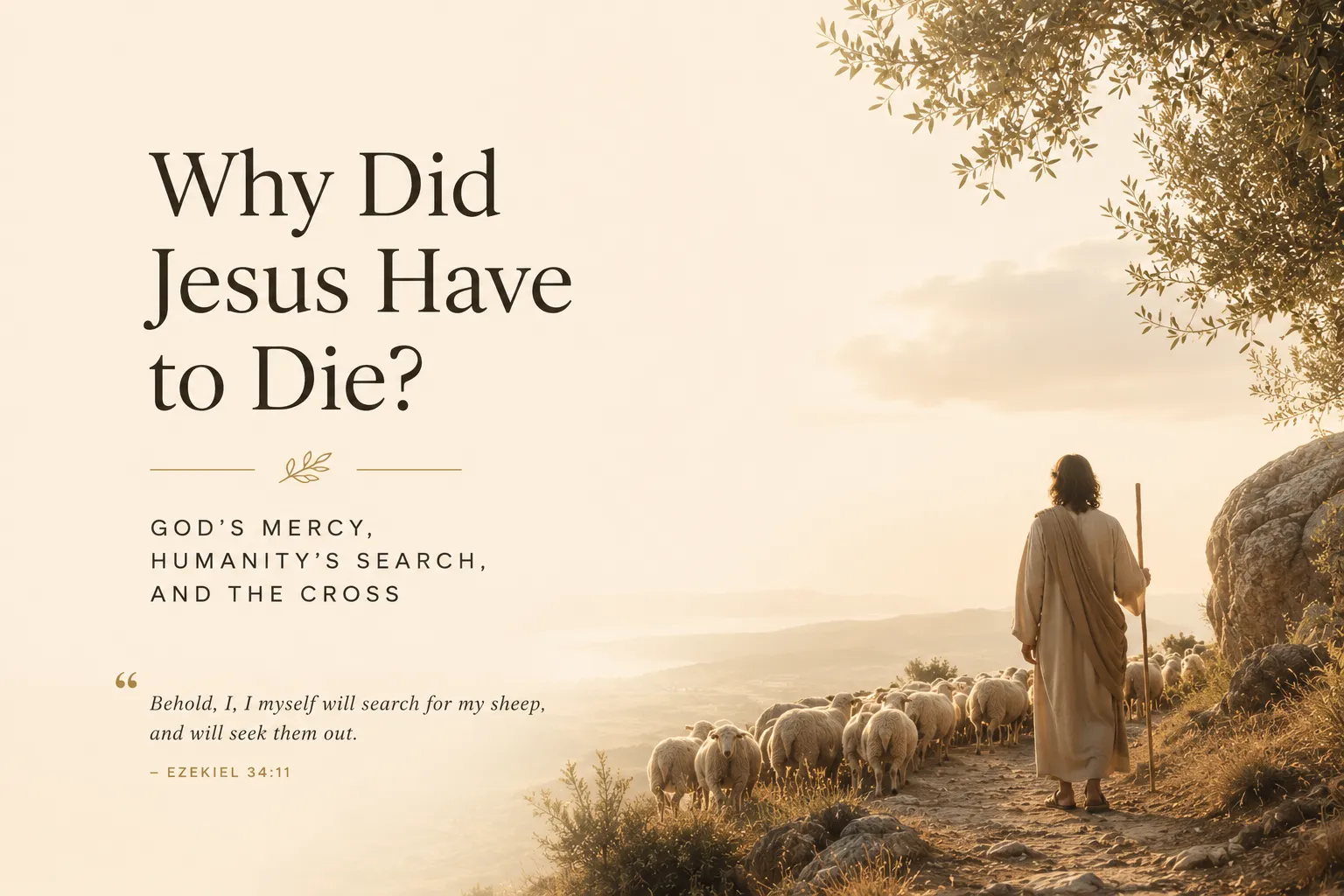
For this says the Lord GOD: Behold, I, I myself will search for my sheep, and will seek them out. As a shepherd seeks out his flock when some of his sheep have been scattered abroad, so will I seek out my sheep; I will rescue them from all places where they have been scattered on a day of clouds and thick darkness
Ezekiel 34:11-12
Notice who promises to act. Not another prophet. Not another king. God Himself. Christians believe Isaiah was not merely describing a future servant. He was describing Jesus Christ. The One who came not only to teach the way back to God, but to accomplish what humanity could not accomplish for itself.
Where is God’s love in Jesus sacrifice?
At first, one may ask: where is God’s love in sacrifice? Even He said that He takes no pleasure in death. To answer this, we must first ask: who is Jesus?
Greater love has no man than this, that a man lay down his life for his friends.
John 15:13
Christians do not believe that Jesus was merely a righteous man sent to die in humanity’s place. The Gospel of John opens with something far greater:
In the beginning was the Word, and the Word was with God, and the Word was God.
John 1:1
The One who came into the world was not a stranger to God. He was the eternal Word of God. This is why Jesus words in John 8 are so striking. When Moses asked God for His name, God answered:
Then Moses said to God, “If I come to the sons of Israel and say to them, ‘the God of your fathers has sent me to you,’ and they ask me, ‘What is his name?’ what shall I say to them?” God said to Moses, “I AM WHO I AM.”
Exodus 3:13-14
When Jesus was preaching to the Jews and they kept asking him questions because they didn’t believed him, Jesus said:
Your father Abraham rejoiced that he was to see my day; he saw it and was glad” The Jews then said to him, “You are not yet fifty years old, and have you seen Abraham?” Jesus said to them, “Truly, truly, I say to you, before Abraham was, I am.”
John 8:56-58
The reaction of His listeners is telling. After Jesus declared, “Before Abraham was, I am,” they took up stones to throw at Him (John 8:59). They understood that Jesus was claiming far more than mere age or wisdom. He was identifying Himself with the divine name revealed to Moses.
When Philip says, “Lord, show us the Father”, Jesus answered,
Philip said to him, “Lord show us the Father, and we shall be satisfied.” Jesus said to him, “Have I been with you so long, and yet you do not know me, Philip? He who has seen me has seen the Father; how can you say, ‘Show us the Father’? Do you not believe that I am in the Father and the Father is in me? The words that I say to you I do not speak on my own authority; but the Father who dwells in me does his works. Believe me that I am in the Father and the Father is in me;”
John 14:8-11
This is why the Cross cannot be reduced to an angry God punishing someone else. Christians believe something far more astonishing: God Himself entered His creation in the person of Jesus Christ,
“It was unworthy of the goodness of God that creatures made by Him should be brought to nothing.”
St. Athanasius, On the Incarnation, chapter 6
Humanity’s destruction was not something God was willing to abandon us to.
The Transfiguration gives us a glimpse of this mystery. Moses and Elijah appear beside Jesus - the Law and the Prophets standing with the One they pointed towards,
And he was transfigured before them, and his face shone like the sun, and his garments became white as light. And behold, there appeared to them Moses and Elijah, talking with him.
Matthew 17:2-3
The Law pointed forward. The Prophets pointed forward. Isaiah spoke of the suffering servant. Now the Son stands before them, and as if to remove any doubt, the Father declares from heaven:
This is my beloved Son, with whom I am well pleased; listen to him.
Matthew 17:5
The story that began in Eden, continued through the covenants, and was proclaimed by the prophets finds its fulfilment in Jesus Christ. But why did the Son come? St. Irenaeus offers a beautiful answer,
“The Word of God, our Lord Jesus Christ, through His transcendent love, became what we are, that He might bring us to be even what He is.”
St. Irenaeus, Against Heresies, Book V, Preface
So where is God’s love in Jesus sacrifice? It’s in here: God did not remain distant from humanity’s wound. He entered it. He took on our flesh, bore our sins, and laid down His life for us. No earthly analogy can fully explain the mystery of the Cross, but one sermon illustration has stayed with me, was about about a king who was known as as being just.
Now this king had a son who was a bit of a miscreant and got caught doing a severe crime. The punishment for that crime was death, so the king had to make a choice, if he ignores the crime, he is no longer just and opens a precedence for future crimes.
The sentence of the crime was death. But as they prepare to execute his son, the king stops them, steps down from his throne and beared the punishment himself.
God comes downward to rescue humanity.
In Eden, humanity reached upward seeking to become like God through disobedience. In Christ, God came down to humanity in love and obedience. The Cross is not the absence of God’s love. It’s the place where God’s justice and mercy meet - where the King steps down from His throne and bears the cost Himself.
For as in Adam all die, so also in Christ shall all made alive.
1 Corinthians 15:22
Patristic Translation Pipeline
Over the last few weeks I've been building a pipeline for working with patristic texts. The original reason for building it was much more...
31 Aug 2026One more articleWhose Good Am I Seeking?
Paul tells us to seek the good of others. Ezekiel shows the danger of self-serving shepherds, while Jesus reveals true love in the Good Shepherd who gives Himself.
Reflections · 26 Aug 2026